
Courtney's Design Tips
Should you upgrade builder-grade finishes in new construction at the design center or after closing? A guide for Prosper, Celina and Anna
Which builder-grade finishes to upgrade at the design center in a new Prosper, Celina or Anna home, which ones to change after closing, how to compare the two prices in writing, and what to check in your warranty and with your town.
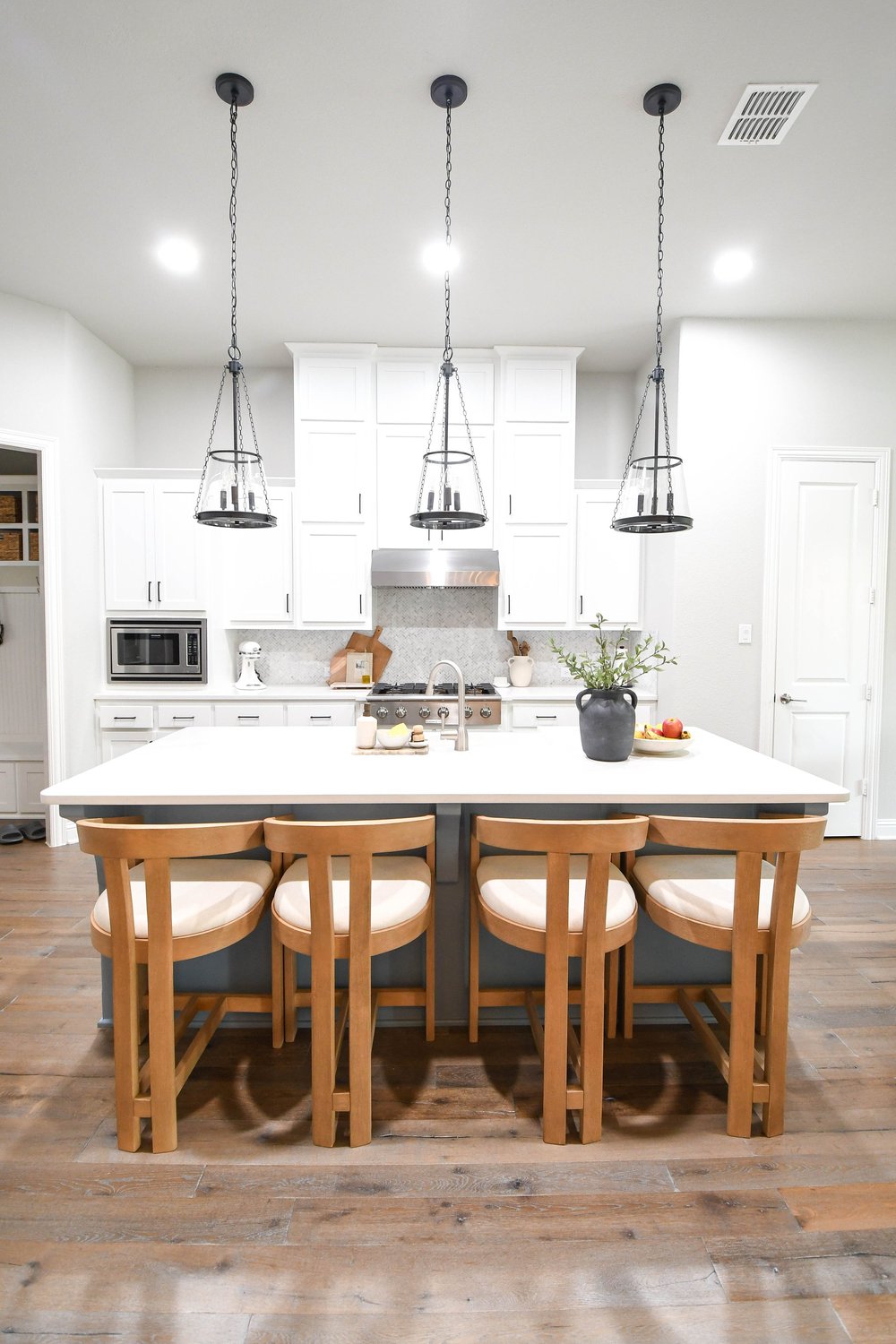
If your home is new construction in Prosper, Celina or Anna, upgrade the builder-grade finishes that get built into walls, ceilings and floors at the design center. Leave the finishes you can unscrew or repaint for after closing. Wiring, ceiling boxes, plumbing locations, wall blocking, shower tile and flooring that runs through the house are hard to change once drywall and floors are down. Paint, light fixtures, cabinet hardware, faucets and mirrors swap out later without opening anything. For the items in between, get the design center’s price and an after-closing quote for the same item in writing, then compare.
Which builder-grade finishes should you upgrade at the design center?
Upgrade at the design center any finish in a new Prosper, Celina or Anna home that is wired, plumbed, framed or set in tile before the walls close. Changing those items after closing means cutting into brand-new drywall, tile or concrete, then patching and repainting. During construction, the builder’s crews put the item in on the normal schedule.
The items that usually belong on your design-center list:
- Electrical rough-in. Ceiling boxes for pendants over the island and the dining table, outlets inside a pantry or at TV height, switched outlets for lamps, and wiring for under-cabinet lights.
- Plumbing locations. Where the shower valve and head sit, a second sink, a gas line to the range. If your house sits on a concrete slab, as many North Texas houses do, moving a drain later can mean cutting concrete.
- Blocking in the walls. A few pieces of wood between the studs hold a TV mount, floating shelves, a heavy mirror or grab bars. It costs little while the studs are open. Adding it later means opening the wall.
- Cabinet height. Upper cabinets in a builder kitchen often stop about a foot short of a nine- or ten-foot ceiling, with an empty box over them. It is one of the first builder details owners of newer North Texas homes ask a remodeler to undo.
- Shower tile and layout. Wet-area tile sits on a waterproofing layer. Changing it after closing is demolition, not decorating.
- Flooring that runs room to room. A plank added later may not match the dye lot or may be discontinued, which leaves a seam at a doorway.
Which builder-grade finishes can wait until after closing?
The builder-grade finishes that can wait until after closing are the ones you can change without opening a wall or lifting a floor. That list covers paint, light fixtures on boxes that already exist, cabinet hardware, faucets, mirrors, window treatments and, in many kitchens, the backsplash. You can buy these from any supplier, and you get to choose them after you have seen your rooms in morning and evening light with your furniture in them.
Lighting shows why the order matters. A lot of new-build rooms feel flat because the builder lit them with ceiling cans alone. If you pay for the ceiling boxes and switch locations at the design center, the fixtures themselves can wait, and you can pick them once you know the room.
Countertops sit in the middle. A countertop can be replaced after closing, but the backsplash, sink and sometimes the faucet come off with it, so price both paths before you decide.
Are design center upgrades worth it?
Design center upgrades are worth it for finishes that are hard to reach after closing, and worth testing for everything else. Builders set their own option prices, so the only reliable answer for your house is two written prices for the same item. One comes from the design center, and one is a remodeler’s quote for the same work after you move in.
Finishes are a large share of what you are buying either way. The National Association of Home Builders published its Cost of Constructing a Home survey for 2024 on January 23, 2025. Interior finishes were the largest single stage of construction, at 24.1% of construction cost for a typical builder’s single-family home nationally. Construction itself was 64.4% of the average sales price in that survey. Those are national averages, not prices for any Prosper, Celina or Anna builder.
Before you sign selections, ask the sales office one more thing: whether upgrades are paid at contract or rolled into the price of the home. The answer changes how much each upgrade really costs you.
Builder upgrades vs. after closing: how do you compare the two prices?
You compare builder upgrades with work done after closing by pricing the same item, at the same size and quality, both ways. Then write down what each price includes. The table lists what to ask for on each side.
| Finish | At the design center, ask for | After closing, ask the remodeler for |
|---|---|---|
| Island and dining pendants | Number of ceiling boxes, switch location, price per box | Price to add a box in a finished ceiling, including drywall patch and paint |
| Extra outlets and under-cabinet lights | Count, exact locations, hardwired or plug-in | Price to run wire through finished walls and patch |
| Upper cabinets to the ceiling | Cabinet line, door style, finished height in inches | Price for stacked uppers or extensions, and whether the existing boxes stay |
| Flooring | Product name, rooms covered, transitions | Price per square foot, and how it meets the builder floor at doorways |
| Shower tile | Tile, layout, niche, waterproofing method | Demolition, new waterproofing, new tile |
| Countertops | Slab level, edge, seam locations | Removal, new slab, and whether the backsplash comes off too |
| Paint and light fixtures | Usually skip | Price once you have lived in the rooms |
For every line, get the brand, model and size in writing, plus who warranties it. An upgrade that looks cheaper at the design center can be a different product from the one a remodeler quotes.
What happens to your builder warranty if you change finishes after closing?
Changes you make to a new home after closing can fall outside your builder’s warranty, so read your own warranty’s exclusions before any work starts. One Texas home warranty booklet shows how this works. The “Austin, TX RWC Warranty Manual” (Rev. 8/19) excludes “modifications or additions to the Home … made after the Effective Date Of Warranty.” Your builder’s document may say something different, and only that document counts.
Before any after-closing work touches plumbing, wiring or walls, ask your builder in writing how that work would affect your warranty coverage. Keep the answer with your closing papers.
Do you need a permit or HOA approval for changes after closing in Prosper, Celina or Anna?
Changes after closing in Prosper may need a permit, depending on the type of project. The Town of Prosper says a hired contractor must obtain the permit for the work they perform and must be registered with the Town. Prosper lists ten business days for the first round of residential plan review, including remodels. The Town also says it does not enforce deed restrictions or HOA covenants, and tells you to verify them before you apply, because they may supersede Town requirements.
In Celina, the city says all contractors must register before applying for permits. For Anna, call the city’s building department before you set a start date. In all three towns, read your HOA’s rules for interior and exterior changes before you sign a contract.
Why does this decision come up so often in Prosper, Celina and Anna?
The finish decision comes up so often in Prosper, Celina and Anna because their housing is young. The median home was built in 2014 in Prosper, 2015 in Celina and 2012 in Anna, according to the U.S. Census Bureau’s American Community Survey 2024 five-year estimates. The same survey puts the median owner-estimated home value at $823,700 in Prosper, $509,600 in Celina (with a wide margin of error) and $351,700 in Anna.
Price tier changes the math. In Anna, an upgrade a Prosper buyer might shrug at is a bigger share of the house, so the written comparison matters more. In Prosper, the higher price makes it tempting to say yes to every option on the sheet, which is exactly when the in-wall list keeps you focused.
Waiting can stretch on. Two years after moving in, one Lively Luxury Designs customer was still “trying to figure out what to do” with the house. Another wrote of “five projects” done “in our new home.”
Should you hire an interior designer for new construction finishes in Prosper?
Hiring an interior designer for new construction finishes in Prosper, Celina or Anna pays off when you face a long selection sheet and cannot yet picture the rooms. Design earns its fee where there are decisions to make. If you already know you want white cabinets, a quartz top and black hardware, you do not need one.
Homeowners building in Prosper this year have asked for design help before their design-center appointment. Whenever you bring a designer in, decide on paper first. Changes on a drawing cost nothing. Change orders after cabinets are ordered cost real money and real weeks.
What to do next
If you have not closed yet, take the comparison table to your design-center appointment and get every price in writing. Already closed, and the builder kitchen is the room that bothers you? Read what to change in a builder kitchen in Celina and what changing a builder kitchen in Frisco involves. If it is the primary bath, see what a primary bathroom remodel costs in Prosper.
If you have already closed and want help with the after-closing list, Lively Luxury Designs is a design-build firm with an in-house interior designer who works alongside its remodeling crew. Design is billed at $100 an hour with a ten-hour minimum, and the remodeling work carries a 365-day workmanship warranty. You can see how that works, and book time, on the interior design page.